Showing posts with label Genealogy. Show all posts

Monday, September 3, 2018

Hungarian Village Finders for Newbies

       
 With the exciting updates of the Hungarian collections at Family Search, many new researchers find themselves very confused about WHERE exactly their immigrants hailed from in Hungary. Perhaps one knows the origins through family traditional stories but did not know that the borders of the country has changed many times in the past 300 years or more ?
In the old days, my family swore up and down that their family was never in Hungary but Czechoslovakia. Later on, when I studied the historical timelines, I realized that my family were correct but ultimately placed their village in Slovakia  (only 1/2 mile from the border of Hungary) since the velvet divorce of the Czech Republic and Slovakia in 1993. Technically it was still in Hungary, then their village was in Czechoslovakia for a period of 74 years. Now it's in Slovakia. So in essence, my Great-Grandparents' village lived through three country changes.
One of the neat things happening at Family Search is the wiki for information about anything dealing with finding records for Hungarian or Slovakian, Czechoslovakian villages. 
For my regions, I like to consult RADIX a lot. He is a treasure chest of many resources, especially about finding microfilms at FHL. There is one jewel of a page that lists FHL film numbers which is synced with many gazetteers. It's truly is a lifeline for those of us lost among volgyek and síkságoks and erdők !
There is a product out there in the market. I am not endorsing it as I have never used it but I wanted to mention it for the newbies out there. I always had to deal with a lot of old paper maps and the mapping utilities on the internet but I think if I was starting out again, I may have saved myself many hours by a tool like this one: http://www.hungarianvillagefinder.com/
If you are really stumped to unravel an immigrant's village, you can always post your query at the Hungarian Gen Web or message boards. One is at www.genealogy.com which has been around for a long time so make sure to search the archives there first to see if anyone has asked for the same family name in same location. The specific link for Hungarian posts is : http://genforum.genealogy.com/hungary/.
The other one is at ROOTSWEB: http://boards.rootsweb.com/localities.ceeurope.hungary/mb.ashx. Once again , search the archives there for your village.
My personal favorite way to get help is from the people who run the the list for Hungarian Research: http://lists.rootsweb.ancestry.com/index/intl/HUN/HUNGARY.html. I subscribe to their mailing list.
And there may always be some helpful Hungarian genealogists contributing at >>>: http://www.rootsweb.ancestry.com/~wghungar/
There is also a panel of volunteers who can also help with locations, translations and Hungarian genealogy at the community forum of HUNGARY EXCHANGE which is spearheaded by Nick Gombash. It's a facebook group and you need to join. It's located at https://www.facebook.com/groups/341374479864 .

Wednesday, April 13, 2016

FINDING Barbara Stumpf’s Zell


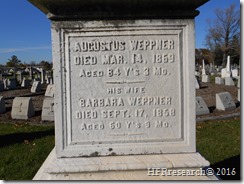
I have been able to connect all but one of my German lines back to their ancestral village. My fourth great - grandmother, Barbara Stumpf of “Zell”[1],  married Augustus Weppner, circa 1817, in either “Zell, Bavaria” or Pfeddersheim. They immigrated to Buffalo, New York in 1834[2] following the birth of the last German-born child in Pfeddersheim[3] . When I started to look for their marriage record, this German line became more challenging than my Millers because there are quite a few “Zells” in Germany. I put that research aside until last month.
 
Barbara Stumpf Weppner Grave Marker. United German & French Cemetery, Cheektowaga, Erie, NY
This morning, I came upon this blog post by Sonja. By the way, if you do German research, Sonja’s blog is a treasure trove. Sonja announced a website that combines the Meyers Orts und Verkehrs Lexikon for searching capabilities in Germany and Poland. I have to say this is an amazing mapping tool! In the old genealogy days, I could only access the Meyers Ort on microfilm at my Family History library. Then I thought it was really cool beans when it could be accessed at Ancestry (in card catalog, search under “Meyers Orts- und Verkehrs-Lexikon des Deutschen Reichs” or “Meyers Gazetteer of the German Empire”).
The MEYERSGAZ site is amazing. It toggles historical maps with the modern maps which will keep me happy for many years to come as I finger walk old maps to solve research dilemmas. It also claims to not “worry about diacritics when searching”. The Ecclesiastical listings show the nearest parishes or synagogues with mileage added. Remember that our ancestors hitched a ride in a wagon or walked to religious rituals so this feature would be really helpful in selecting the microfilms one needs to order.
Hope you will enjoy http://www.meyersgaz.org as much as I do, and thanks, Sonja !

[1] Weppner Family Announcement for ARNOLD WEPPNER Memorial (dated Sept. 5 1900) (n.p: Name: Name: Copy of Original; n.d). Private family archive.
[2] New York Passenger Lists 1820-1957. Year: 1834; Arrival: , ; Microfilm serial: M237; Microfilm roll: M237_24; Line: 19; List number: 696
[3] IGI (Vol. 5, Germany). Batch.#C966491 , Source #0949593


Saturday, April 9, 2016

Epidemics in genealogy


Pandemics and epidemics are a reality of research that cannot be avoided when doing genealogy. When I started genealogy at the age of 17, I was photographing cemetery stones when I landed on one marker‘s inscriptions where the father and his children died all in one day. I wrote about it here.
The other day, I was looking for a particular death record in Csötörtök, Pozsony, Hungary. I am in the years between 1865-1867 and see a cholera breakout.
Pgs. 197-198. Catholic Church Record: Csötörtök, Pozsony, Hungary. Now called Štvrtok na Ostrove, Slovákia
CholeraChurch Record Csötörtök, Pozsony, Hungary1866Pgs. 197-198. Catholic Church Record: Csötörtök, Pozsony, Hungary. Now called Štvrtok na Ostrove, Slovákia

The cause of every death recorded on this page was cholera. Sometimes pages like this one goes on throughout a a length of time in months. By the way, this is a really good pandemic history timeline for references to locations of Cholera outbreaks in the Asia and Europe at this link about Eastern Europe plagues.


sources: Wikipedia: Epidemics

Monday, April 4, 2016

BRICK WALLS and how I log them.


B  Brick Walls.Genealogist will always have them. We stare at the brick wall. We pry the mortar away from each brick and look through the empty hole we created for more clues. Or we just take a deep breathe and jump over the whole brick wall and land in a fields of clues ( clover ? ).
In my One Name Study, I keep a spreadsheet in Google Docs of unidentified people that I need to fit into families. This is what it looks like.
I title each sheet by types of records accessed. I use the surname spellings as they are indexed or viewed on the records. I also insert a direct link to the source.
This example here is a small collection of people in my One Name Study that have been found in ship records or city directories but not actually placed into a family. Sometimes I know what family I will connect them to but did not have time or I need to do deeper research to prove the “connection ”. When I make a connection, I just delete them from the spreadsheet. It’s very satisfying to chisle away at these brick walls. 

Tools that solve Brick Walls in genealogy: Pasport Applications


APPLICATIONS
Applications are the meat-and-potatoes of immigration research. There are many kinds of applications where one can gather such facts as places and dates of birth and marriage for the applicant as well as for their family network .
In my One Name Study, I have been working on connecting my One Name Study constituents in the United States to their places of origin in Eastern Europe. One type is the passport application that are in databases on Ancestry and Family Search. For the United States alone, FamilySearch has amassed, at least, 6 collections ( U.S. Passport Collection at Family Search ). At Ancestry, there are numerous sub-sections but the main one is the U.S. Passport Applications, 1795-1925.
Here is one crown jewel of a find for my One Name Study(2) interest :
StermenskyJoseph

This is Joseph Stermensky’s Passport picture with his signature and a seal that was affixed to his Emergency Passport Applications to “Czechoslovakia”(1).  Not all passport applications bear photographs but a remarkable amount of them started to show up around 1915. Many examples can be seen at this collection mentioned in my other blog.

Here is one page of Joseph Stermensky’s actual passport application which, among other details such as a physical description, states where he lived and where he was headed:
StermenskyJosephPASSapp20June1920NYC
 

(1) - U.S. Passport Applications, 1795-1925, for Joseph Stermensky.28 June 1920. Emergency Passport Applications, Argentina thru Venezuela, 1906-1925.1919-1920.Volume 001: Czechoslovakia. Ancestry. 
(2) -  http://stermenszky.one-name.net/

Tuesday, November 10, 2015

Why I use the "FamilySearch Matches" tool at WikiTree

My family history research and some of my One Name Study has been on WikiTree for years. It's my only online public tree. For reasons why I use WikiTree, please read my earlier article: Zen & the Art of Genealogical Maintenance

WikiTree released a new tool last month. It's called the FAMILYSEARCH MATCHES tool. What it does is matches all your WikiTree profiles to the FamilySearch records or FamilySearch Tree. I was also a beta tester when FamilySearch Tree first started testing their product. When Chris Whitten, the master developer behind WikiTree, created the "FamilySearch Matches" tool, I was, at first, skeptical but now very excited about how it works for my research. To access the FamilySearch Tool, one needs to get to it from their own MY WIKITREE MENU from FIND; slide down to FamilySearch Matches. A window will open up; You will see that it is FamilySearch certified and you need to put in your WikiTree login information as well as your FamilySearch login information.

Next, your WikiTree WATCHLIST will be displayed with potential matches at FamilySearch. In this example, I have one match at the FamilySearch Tree so I clicked that it was a "certain match". If I want to remove the match, I can always do so. You also have the option to check that a match is "uncertain". Now here is the REAL reason why this tool is very exciting ! If you look at where I placed a YELLOW STAR, this is a baptismal record that I did not know that was indexed in FamilySearch under "New York Births and Christenings". I have been finding records, left and right, for all the people in my WikiTree Watchlist !
When this tool finds the record matches, it does not transfer the records automatically to your WikiTree profiles. What I do is copy the source citation from the new record at FamilySearch and paste it in the WikiTree profile (I always work with two windows open). Chris Whitten explains at length about FamilySearch Matches in this document: You can also click on the "more info" link which is at the top of the FamilySearch Matches list.

The great thing that WikiTree DOES DO is add a MATCH LINK automatically on the WikiTree profile that looks like this:

It's important to note that the WikiTree FamilySearch Matches, like the FamilySearch Tree and records, is user-generated. Therefore, the information may be incorrect and needs to be verified by the researcher (that's you !). I actually have not had one wrong match and I have 1662 profiles. I think a lot depends on how much data entry are in your WikiTree profiles to get the closer matches but I have had so many surprises, especially for my One Name Study profiles. The great thing about this RESEARCH section is that you can quickly check from your WikiTree profiles if new matches or records have been located.

By the way, in terms of navigating the FamilySearch Matches Watchlist, there is a pagination tool on the bottom that's very handy.

Sunday, April 7, 2013

Zen & the Art of Genealogical Maintenance

zen

Apply to your genealogical matters :

"You look at where you're going and where you are and it never makes sense, but then you look back at where you've been and a pattern seems to emerge".

"The pencil is mightier than the pen.”

“For every fact there is an infinity of hypotheses. ”

“The test of the machine is the satisfaction it gives you. There isn't any other test. If the machine produces tranquility it's right. If it disturbs you it's wrong until either the machine or your mind is changed.”

― Robert M. Pirsig, Zen and the Art of Motorcycle Maintenance: An Inquiry Into Values

How many years have you been doing genealogy? What do you have to show for all your hard research, encased in your gedcoms programs on your computers ? Are they bundled in file boxes of notebooks and if you found time, you patiently printed out pages of your work ? This is not an article about genealogical organization; there are plenty of them out there.  I was recently inspired by Valerie Elkins Brown when ROOTSTECH 2013  live-streamed  her "gen-organization"  talk. Her motto was to give yourself a break and do it your way.

Three things that strikes me these days when I look at my genealogical life  :

1) Less is more

2) Don't be a genealogical hoarder

3)  Keep it simple.

I have been doing it various ways, for many years, rotating different methods through desktop genealogy software. Life got busy and there were more challenges in getting the research out there which became more stressful. Then I read this inspiring article written by Lianne LaVoie of "Stories of a Canadian Family": http://www.wikitree.com/blog/using-wikitree-to-organize-your-genealogy/

Like Lianne, I use Wikitree all the time. I research with one tab open and make a profile in the other tab in WikiTree. Sometimes I categorize the profiles by locations. Sometimes I edit, write some biography or post a follow-through on the sources I have accessed. WikiTree is a great genealogy cloud if your hardware at home fails. I am not big on uploading gedcoms to public trees so I enter my findings one-by-one manually as I work which helps me analyze my research deeper. It's extremely convenient to access wherever I am located. It works great on my Kindle Fire when I am traveling.There are many "widgets" to view your input. I like the privacy settings, the geocoding and the printing capabilities. I can also upload images of documentation (like a free cloud). I did not mention the side benefit of other family collaborators that found me on WikiTree.

My family research is still lodged on my computer software and I will always have my spreadsheets but it's very liberating to use WikiTree to share your research. I am not going to say anymore on how WikiTree can help you but it's working for me. You can become a guest at www.wikitree.com to see if the WikiTree way works for you and then, join, for free.

Monday, March 25, 2013

Military Monday : Adam Upperman of Philadelphia, a Hessian Soldier who became a Patriot.


       Adam Upperman ( Opperman ) is listed among the Hessians who signed the Oath of Allegiance in the State of Pennsylvania between 1777 and 1789. This list was taken from the book by Thompson Westcott, “Names of Persons Who Took the Oath of Allegiance to the State of Pennsylvania between the Years 1777 and 1789, with A History of the “Test Laws” of Pennsylvania.”3

The Hessian soldiers were mercenary soldiers that were employed by the English to fight for the British's goal of squashing the spirit of American independence. They were hired in units, not as individuals and deployed by their princes in Germany. They received wages, but the prince of their respective states received most of the funds; Britain found it easier to borrow money to pay for their service than to recruit its own soldiers 7

A mercenary soldier usually have no ties to any country. Wikipedia defines them as " soldier who fights, or engages in warfare primarily for private gain, usually with little regard for ideological, national or political considerations. However, when the term is used to refer to a soldier in a regular national army, it is usually considered an insult, epithet or pejorative."  A response from a moderator5  on the genealogy mailing list at roots web ( AMREV-HESSIANS-L) said that the term as used in the Declaration of Independence, WAS USED AS AN INSULT. It did not correctly name these soldiers, and it was because of this insult that some families hid their Hessian ancestors
After the war ended in 1783, 17,313 Hessians returned to their homelands with about 5000 remaining in America.

Adam Opperman , born in 1757 in Hachborn, Hesse-Kassel,Germany, did not go back. Four years previously, he served in the Hesse-Kassel Jäger Corps and while marching through with his troop through New Jersey, he fled and deserted them. He married an American girl, pledge allegiance to the State of Pennsylvania and became a Patriot.
A "Patriot" was someone in the Colonies who fought for our independence from the King of England. (There is an addition to this, which was a person who assisted in some other way can also be considered a patriot.) Taken from Hessians who signed the Oath of Allegiance in the State of Pennsylvania 1

Pg. 77
Aug. 6, 1782
Francis Otto, deserted the Brittish Service about 4 years, a Hessian; by trade a book-binder.
Johannes Parkmann, deserted the Brittish Service & Hessian Line about one year; by trade a tanner & currier.
Johann Bishop, deserted the Brittish Service & Hessian Line about one year; by trade a Shoemaker.
Adam Opperman, deserted the enemy & Hessian line about 4 years; by trade a Weaver.
William Garman (his mark), a Hessian deserter from New York; Labourer.
 
Merz, Johannes Helmut. Guide to help you find your Hessian soldier of the American revolution [Hamilton, Ont. : J.H. Merz, 2001]
 

His surname was Americanized to " Upperman" shortly after he swore allegiance to Pennsylvania in 1782.
  1. http://freepages.military.rootsweb.ancestry.com/~bonsteinandgilpin/oath.htm
  2. http://www.staatsarchiv-marburg.hessen.de/irj/HStAM_Internet
  3. Thompson Westcott, “Names of Persons Who Took the Oath of Allegiance to the State of Pennsylvania between the Years 1777 and 1789, with A History of the “Test Laws” of Pennsylvania.”.
  4. Merz, Johannes Helmut. Guide to help you find your Hessian soldier of the American revolution [Hamilton, Ont. : J.H. Merz, 2001]
  5. Nelda Percival is the web moderator of  the AMREV-HESSIAN MAILING LIST WEBSITE.
  6. Merz,Johannes Helmut Deserters of the Hesse-Kassel Fields- Jaeger Corps, in Hessian Guide:Hessians remaining in America [Johannes Helmut Merz, 72 , 2005, Secondary quality].
  7. http://en.wikipedia.org/wiki/Hessian_(soldiers)