Showing posts with label Hungarian research. Show all posts

Monday, September 3, 2018

Hit a brick wall looking for your Hungarian ancestor? Try this site.

Vic Berecz has been working on his Hungarian family history for a long, long time. He created a tutorial on how to attempt one's genealogical research in Hungary that I have always checked now and then for updates. It's very comprehensive and answers a lot of questions about looking for your roots in Hungary. Here is how he laid out some basic questions on his FAQ page.
  • Hungary is a huge topic. You must have a focus here. What is it?
  • Will the cost and effort of tracing my family history in Hungary be worth it?
  • What are the geographical issues involved in tracing your Hungarian roots?
  • What are the chronological issues you face tracing your Hungarian roots?
  • If the Internet is so great, why not just show us how to find our ancestors there?
and so on. The section about the Timeline for Hungarian Vital Records is really worth bookmarking for a quick study before attempting records search. A lot of care and thoughtful explanations are in his methods. He also paints in a lot of historical background information that will aid the novice researcher researcher.
So do yourself a favor, and look around this very helpful website at Vic Berecz's Hungarian Tutorial.
By the way, enjoy reading his own Family's history at Berecz-Luhr's Family History which is chockfull of tenacious research, wonderful pictures and endless stories ! 

 Barney Blum, 1995.@Victor G. Berecz, Jr.

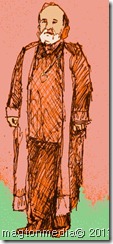
Artwork attribution "Vic the Computer Professor" by cartoonist Barney Blum, 1995.@Victor G. Berecz, Jr.

Keresztszülő ~ Godparents and their genealogical importance

KOMA
According to a Hungarian-English dictionary, komaasszony means the godmother of my child;  komám means godfather of my child

"Keresztapa" and "keresztanya" are the actual literal translation of godparents. When working with baptismal records of mostly Hungarian babies, one will notice a custom that differs from the typical godparent designation in the records of other cultures. Most cultures in the European tradition use the siblings of the baby's parents, or the siblings, first cousins or even the grandparents of the baby. Recent immigrants fresh on American soils also used family, the nearest immigrant from the same village, or lastly, a neighbor or another couple that also was having a baby baptized that same day .

But Hungarians tend to like having their buddies for godparents. It's a tradition. And then, the same guy - and his wife (sometimes his daughter or sister if he was not married or widowed) will be the godparents for ALL the children of this same couple. If the godfather happen to die while that couple were still in their child-bearing years, the deceased godparent was replaced by his son or someone from his family to represent him. Although he  could also be replaced by another "Koma" which is like a long-term buddy from youth or bachelorhood, also used as "crony", "friend" or the word "brother", as in the labor unions.

Felix Game, an Austrian Hungarian genealogist, once posted at the Hungary- L list the importance of paying attention to the roles godparents - or the Koma - played in a child's life when working with genealogical records. He mentions, "Often they reciprocate and be each other's 'koma', but not always. Felix also elaborated further in his article 'Preponderance of Evidence' "The fact that the same man will normally act as godfather for all the children, is already a big help when trying to place a child into the correct family. The big bonus is that the godfather has an important privilege: he must be the first one asked to be a witness at his godchild's marriage. If you have seen situations (and who hasn't), where two or three men exist in the same village, and two of them marry girls with the same names, and then you find that two of the fathers also have the same first names, then you know how important it is to have some other dependable way to sort out these people. Look for the name of the witness on the baptism record, you should find him as the godfather.". I highly recommend reading Felix's article on how to use godparents to sort out children born with the same names in the same time period in genealogical investigation.

I further elaborate the role the Koma plays in genealogical research by citing from Peter D. Bell's book, Peasants in Socialist Transition: Life in a Collectivized Hungarian Village, He writes "KOMA - the godfather of a villager's child, or a male for whose children one is a godparent, is one's koma. Such individuals reciprocally refer to each other as koma................ Although more limited in scope than the relationship between relatives, the koma tie was often strong and more emotionally intense than many non- immediate kin ties. In some ways, koma relationship combined the tone of friendship and kinship. This was a function partly of the koma role itself and partly of the fact that koma  generally were chosen from among close friends and often from among relatives. ........... The baptismal koma chosen by a husband or a couple has once usually been one of the best friends of the husband, more often from childhood or bachelorhood. Indeed, " koma" often means just that - a good, male friend of the same age group or a bachelor band of one's youth."  Peter D. Bell further explained the extensions of the Koma in a child's life, by saying  that in most cases, the baptismal godfather were also chosen to be confirmation godparent and was a witness to their wedding.

Whatever the tradition, I have noticed the reciprocity of the godparents in the life of the child. In my own research, I have traced the godparents/koma later being the  "násznagy" at the child's wedding later. In fact, my own Great-Great-Grandfather, Karol Stermenzsky, married the daughter of his godparents who were also his father's " Koma. These are important to note when reading genealogical records and doing cluster studies of your ancestral families. 
 
1) Peasants in Socialist Transition:Life in a Collectivized Hungarian Village.University of California Press, 1984.
2) Preponderance of Evidence. By Felix Game .Austro-Hungarian Web Site : http://www.felix-game.ca/html_files/prepond.html
3)Post from Felix G. Game on Hungary-L. Hard copies owned by me.
4)HUNGARIAN - ENGLISH DICTIONARY : http://www.genealogy.ro/dictionary/hun_eng_k.htm.